Invoice Finance for Scaffolding Companies
Release instant cash from unpaid invoices
- Receive up to 95% of invoice value
- Sell single or multiple invoices
- Fast, stress-free funding in 24 hours
Quick Decision with No Obligation

Release instant cash from unpaid invoices
Quick Decision with No Obligation
Invoice finance for scaffolding companies is a funding solution for businesses that invoice commercial customers, including main contractors, housebuilders, developers and subcontractors. It allows you to unlock cash tied up in unpaid invoices instead of waiting 30, 60 or even 90 days for payment.
Scaffolding businesses often face significant upfront costs before invoices are settled, from transporting, erecting and dismantling scaffolding to maintaining stock, paying CISRS-qualified labour and meeting CITB and NASC-related compliance costs. Invoice finance helps improve cash flow by releasing funds against eligible invoices, providing working capital while customers complete their payment terms.
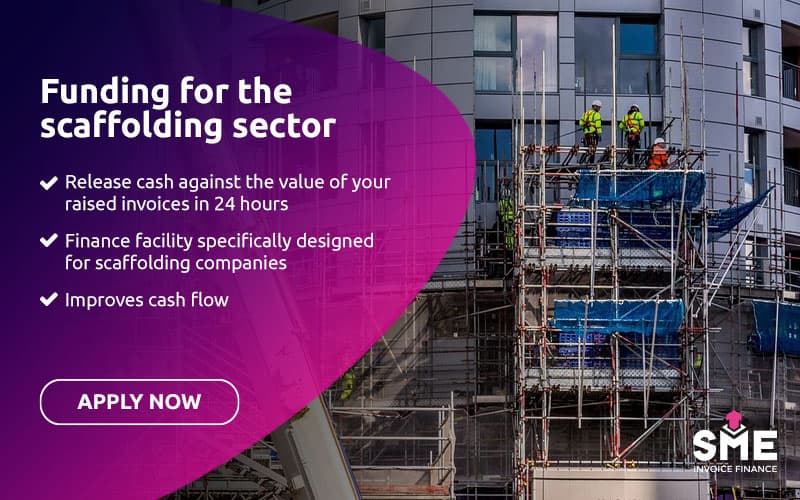
Scaffolding contractors commonly work on payment terms agreed under JCT or bespoke construction contracts, where invoices for erection, adaptation and dismantling stages may not be paid for several weeks or months. At the same time, wages, transport, scaffold stock and operating costs must still be covered.
Cash flow can be further affected by retention clauses, where part of the invoice is withheld until final sign-off, and CIS deductions on labour-related invoices. Invoice finance helps bridge these gaps by releasing funds against eligible invoices before payment is received.
Improved cash flow gives scaffolding businesses the confidence to pay employees and subcontractors on time, invest in scaffold stock, cover transport and yard costs, and take on new contracts without being held back by slow-paying customers.
Did you know? Around £4.5 billion is estimated to be tied up in construction retentions across the UK each year, with 44% of contractors reporting lost retention payments due to upstream insolvency. For scaffolding businesses, retentions held until final strike-down and sign-off can delay access to completed contract value while labour, stock and transport costs still need to be paid.
There are several types of invoice finance available, depending on how you want to manage customer payments.
Scaffolding invoice factoring lets a finance provider manage collection of payments from your main contractor or client, while releasing funds against your outstanding hire-and-erect invoices. This can suit scaffolding businesses that want to improve cash flow while reducing the time spent chasing payment from contractors on multiple sites.
Scaffolding invoice discounting releases funding against unpaid invoices while allowing you to retain control of customer relationships and credit control. It's often suited to established scaffolding contractors with their own finance team.
Selective invoice finance (also known as single invoice finance) allows scaffolding companies to release funds from individual invoices rather than their entire sales ledger. This can be ideal for businesses that only need occasional funding, such as for a large hire-and-erect contract or a one-off adaptation project, without committing to an ongoing invoice finance facility.
Many scaffolding companies work as part of larger construction projects alongside contractors, developers and subcontractors. If your company also undertakes wider construction work, our construction invoice finance guide explains how invoice finance supports businesses across the construction sector.
Invoice finance uses eligible business invoices as security for funding. Once you've completed a stage of work and issued an invoice, a finance provider can advance most of its value before your customer pays.

Send eligible business invoices for completed scaffolding work to the finance provider.

Receive an advance of up to 95% of the invoice value, often within 24 hours.

Once your customer pays the invoice, the remaining balance is released, minus any agreed fees.
Yes, invoice finance can be suitable for scaffolding companies that issue invoices to other businesses. This includes scaffolding contractors working under hire-and-erect or labour-only contracts with main contractors, housebuilders and developers.
The amount available depends on factors such as your invoices, customers, trading history and the finance provider. Many providers can fund a percentage of eligible invoices rather than offering a fixed loan amount.
Yes. Retentions are common in scaffolding contracts and can leave a percentage of the invoice value tied up until the scaffold has been struck and the project signed off. While invoice finance generally applies to the non-retained portion of an invoice, many providers understand how retention clauses work in the construction industry and can explain how they may affect the funding available.
Many scaffolding invoices include a labour element subject to CIS deductions. Invoice finance providers who work with construction businesses are generally familiar with CIS and can factor this into how funding against your invoices is calculated.
This depends on the type of invoice finance used. Scaffolding factoring involves the finance provider managing collections, while scaffolding discounting lets you retain control of contractor relationships and payment collection.
SME Invoice Finance helps UK businesses compare invoice finance options from a panel of providers through an online comparison platform. Rather than approaching multiple finance providers individually, businesses can explore potential funding solutions based on their needs and circumstances.
Whether you're a scaffolding contractor managing regular hire-and-erect projects, working with retentions and CIS deductions, or an established business looking to improve cash flow, we can help you compare invoice finance options and access funds tied up in unpaid invoices.
Apply NowQuick Decision with No Obligation
Since 2014, we've helped many businesses, large and small, get access to the working capital they need through invoice financing.
Some of the funders we work with